Creatinine
Also called Cr.
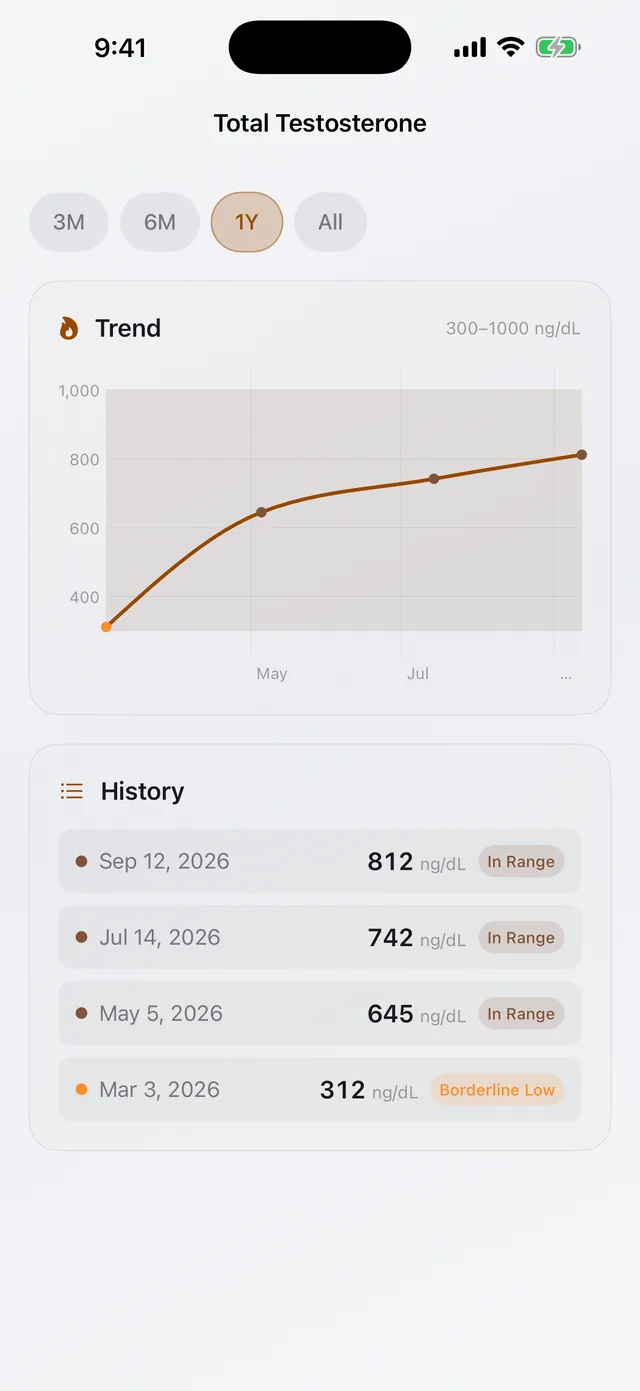
Creatinine is a muscle breakdown product cleared by the kidneys. In My TRT App you can log Cr after each draw and see it next to your dose history. Each lab sets its own reference range, so compare against the range printed on your report.
What it is
Creatinine is a muscle breakdown product cleared by the kidneys. It's the simplest kidney function marker, but heavily influenced by muscle mass.
Reference range
| Reference range | Unit |
|---|---|
| 0.7 – 1.3 | mg/dL |
Reference: 0.7–1.3 mg/dL. Higher in muscular men — don't panic at 1.3–1.5 if you're built.
What moves it
- Kidney dysfunction, dehydration, high muscle mass, recent intense exercise, high protein meal, creatine supplementation.
- Low muscle mass, severe liver disease.
On TRT
TRT increases muscle mass, which raises creatinine independently of kidney function. Use eGFR (which accounts for age/sex) rather than creatinine alone, and cystatin C if you want a truly muscle-independent kidney marker.
Related markers
FAQ
What is a normal creatinine level for men?
For adult men, a typical normal serum creatinine range is roughly 0.74 to 1.35 mg/dL, though ranges vary slightly by lab. Because creatinine comes from muscle metabolism, muscular men naturally sit at the higher end of normal — or even a touch above — without any kidney problem. It's best interpreted through eGFR, which factors in age and sex, rather than the raw creatinine value alone.
Is creatinine the same as creatine?
No, though the names are easily confused. Creatine is a compound found in muscle and taken as a supplement to support strength and power. Creatinine is the waste product left over when creatine and muscle tissue break down, and it's what the lab measures to assess kidney function. They're related but not interchangeable.
Do creatine supplements raise creatinine and hurt my kidneys?
Creatine supplementation can raise your blood creatinine modestly because more creatine in the muscle means more creatinine byproduct — but this is a measurement artifact, not kidney damage. In healthy people, standard creatine doses have not been shown to harm the kidneys. The catch is that the higher creatinine can mechanically lower a creatinine-based eGFR and make kidney function look worse than it is.
How can I check kidney function if I lift or take creatine?
Ask for a cystatin-C-based eGFR. Cystatin C is a protein filtered by the kidneys that doesn't depend on muscle mass, so it isn't skewed by heavy training or creatine supplementation the way creatinine is. Comparing creatinine-based and cystatin-C-based eGFR gives a fairer picture of true kidney function in muscular men, and your physician can order it if your creatinine looks borderline.
Read it in context, not alone.
One Cr result is a snapshot. Logging each result in My TRT App next to your dose timing gives you and your prescriber a clearer picture over time.
Last reviewed 2026-09-02. Education only, not medical advice. Always talk to your prescriber.
Log this marker after every draw.
Scan your lab report and see each result on a trend line.