C-Reactive Protein
Also called CRP.
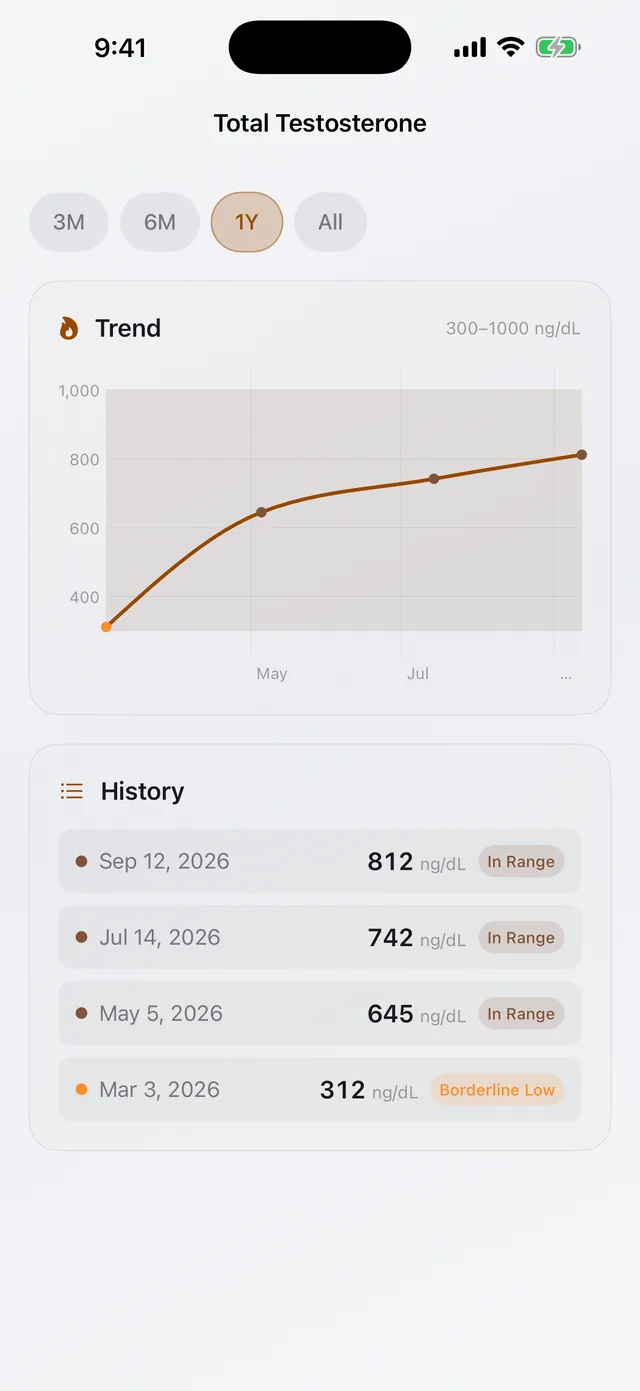
CRP is a general marker of systemic inflammation. In My TRT App you can log CRP after each draw and see it next to your dose history. Each lab sets its own reference range, so compare against the range printed on your report.
What it is
CRP is a general marker of systemic inflammation. High-sensitivity CRP (hsCRP) also predicts cardiovascular risk.
Reference range
| Reference range | Unit |
|---|---|
| < 3 | mg/L |
<1.0 = low risk. 1.0–3.0 = average risk. >3.0 = high risk. >10 usually means acute illness.
What moves it
- Acute infection, chronic inflammation, autoimmune disease, obesity, smoking, periodontal disease.
- Healthy baseline.
On TRT
TRT often modestly lowers CRP via fat loss and metabolic improvement. Chronically high CRP on TRT signals an unaddressed inflammatory source.
Related markers
FAQ
What is a normal CRP level?
For high-sensitivity CRP used to gauge cardiovascular risk, under 1.0 mg/L is low risk, 1.0-3.0 mg/L is average risk, and above 3.0 mg/L is higher risk. A standard (non-high-sensitivity) CRP is used to track infection and inflammation and is usually reported as under about 10 mg/L when normal. A value above 10 mg/L generally reflects acute illness rather than baseline cardiovascular risk.
What is the difference between CRP and hs-CRP?
They measure the same protein, but high-sensitivity CRP (hs-CRP) is a more precise assay that can resolve the low values used for cardiovascular risk stratification (the under 1, 1-3, over 3 mg/L tiers). Standard CRP is coarser and is better suited to detecting and following infection or a flare of inflammation. If you are looking at heart-risk numbers, you want the hs-CRP version.
Why is my CRP high?
CRP rises with any systemic inflammation: infections, injury, autoimmune flares, obesity, smoking, gum disease, and even a hard workout or recent illness can push it up transiently. Because it is nonspecific, a single high reading is often repeated once you are well and rested to see if it settles. Persistently elevated CRP without an obvious cause is worth investigating with your physician.
Does exercise or being sick affect CRP?
Yes. A recent infection, injury, or an unusually hard training session can spike CRP for a few days, which can make a baseline reading look worse than it is. For cardiovascular risk assessment, hs-CRP is best measured when you are healthy and not in the days right after intense exercise or illness. On TRT, CRP often drifts down over time as body fat and metabolic health improve.
Read it in context, not alone.
One CRP result is a snapshot. Logging each result in My TRT App next to your dose timing gives you and your prescriber a clearer picture over time.
Last reviewed 2026-09-02. Education only, not medical advice. Always talk to your prescriber.
Log this marker after every draw.
Scan your lab report and see each result on a trend line.