Thyroid Stimulating Hormone
Also called TSH.
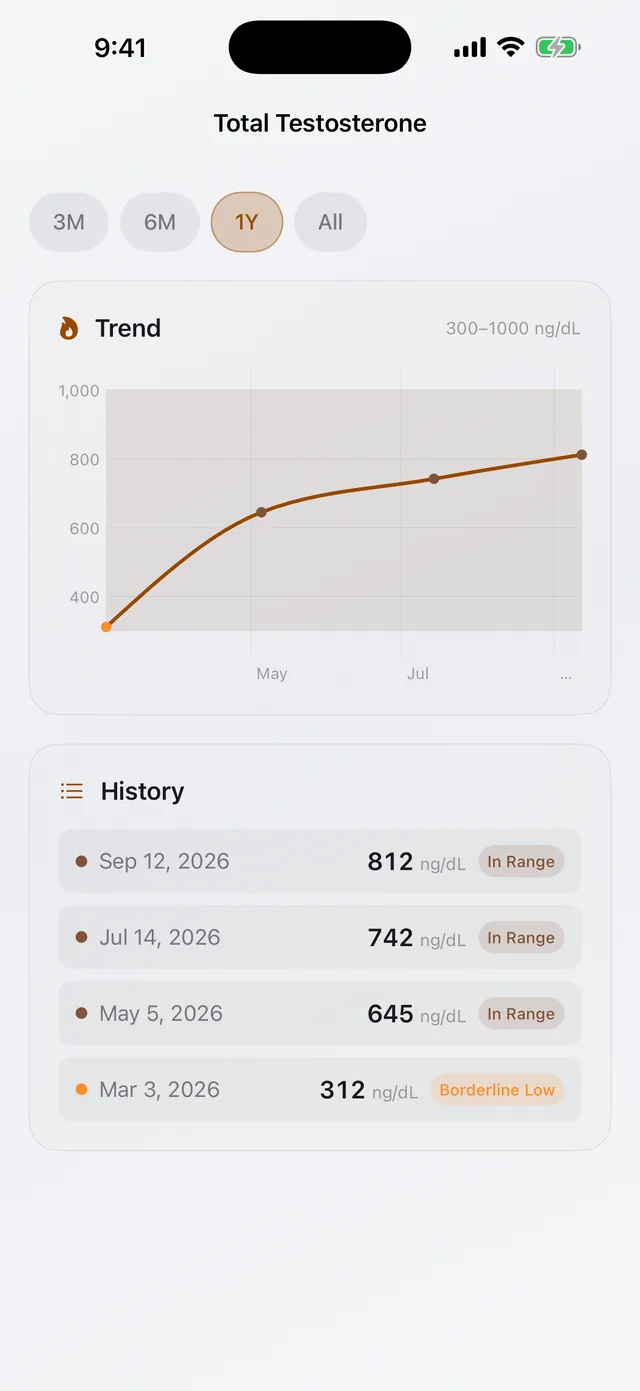
TSH is the pituitary signal that drives thyroid hormone production. In My TRT App you can log TSH after each draw and see it next to your dose history. Each lab sets its own reference range, so compare against the range printed on your report.
What it is
TSH is the pituitary signal that drives thyroid hormone production. It's the most sensitive screen for thyroid dysfunction and worth checking annually on TRT.
Reference range
| Reference range | Unit |
|---|---|
| 0.4 – 4 | mIU/L |
Reference: 0.4–4.0 mIU/L. Optimal: 1.0–2.0 for most adults.
What moves it
- Hypothyroidism (Hashimoto's, iodine deficiency, postpartum thyroiditis).
- Some medications (lithium, amiodarone).
- Hyperthyroidism (Graves', toxic nodule).
- Excess thyroid hormone supplementation.
On TRT
Untreated hypothyroidism mimics low T (fatigue, low libido, weight gain) and raises SHBG, suppressing free T. Hypothyroidism is the most commonly missed reason men on TRT don't feel right despite "perfect" labs. If TSH is >2.5 with symptoms, check free T3 and free T4 and antibodies.
Related markers
FAQ
Can TRT cause thyroid problems?
TRT doesn't directly cause thyroid disease, but autoimmune thyroid conditions cluster with other endocrine issues. Worth annual screening even if asymptomatic.
Is TSH a testosterone test?
No — this is a common mix-up. TSH stands for thyroid-stimulating hormone and measures thyroid function, not testosterone. It's a pituitary signal that tells your thyroid gland how much thyroid hormone to make. Testosterone is a completely separate hormone measured by its own tests (total and free testosterone). They're often ordered on the same panel, which is likely where the confusion comes from.
What is the TRH and TSH connection?
They're two steps of the hypothalamus-pituitary-thyroid axis. The hypothalamus releases TRH (thyrotropin-releasing hormone), which signals the pituitary to release TSH, which in turn tells the thyroid gland to produce T4 and T3. When thyroid hormone levels are adequate, they feed back to suppress TRH and TSH — a self-regulating loop. This feedback design is why TSH is such a sensitive early marker of thyroid trouble.
What does a third-generation (3rd gen) TSH assay mean?
"Third-generation" refers to the sensitivity of the lab test, not a different hormone. Third-gen TSH assays can reliably detect very low values (down to about 0.01 mIU/L), which matters for confirming hyperthyroidism where TSH is suppressed near zero. It's the modern standard and what most labs now run by default.
Why does high TSH mean an underactive thyroid?
TSH works on inverse logic: it's the signal telling your thyroid to work harder, so a high TSH usually means the gland is underperforming and the pituitary is shouting louder to compensate — that's hypothyroidism. A low TSH means there's plenty of thyroid hormone around and the pituitary has backed off, which points toward an overactive thyroid. Reference is roughly 0.4–4.5 mIU/L, with many clinicians favoring 1.0–2.0 as optimal.
Read it in context, not alone.
One TSH result is a snapshot. Logging each result in My TRT App next to your dose timing gives you and your prescriber a clearer picture over time.
Last reviewed 2026-09-02. Education only, not medical advice. Always talk to your prescriber.
Log this marker after every draw.
Scan your lab report and see each result on a trend line.