HDL Cholesterol
Also called HDL.
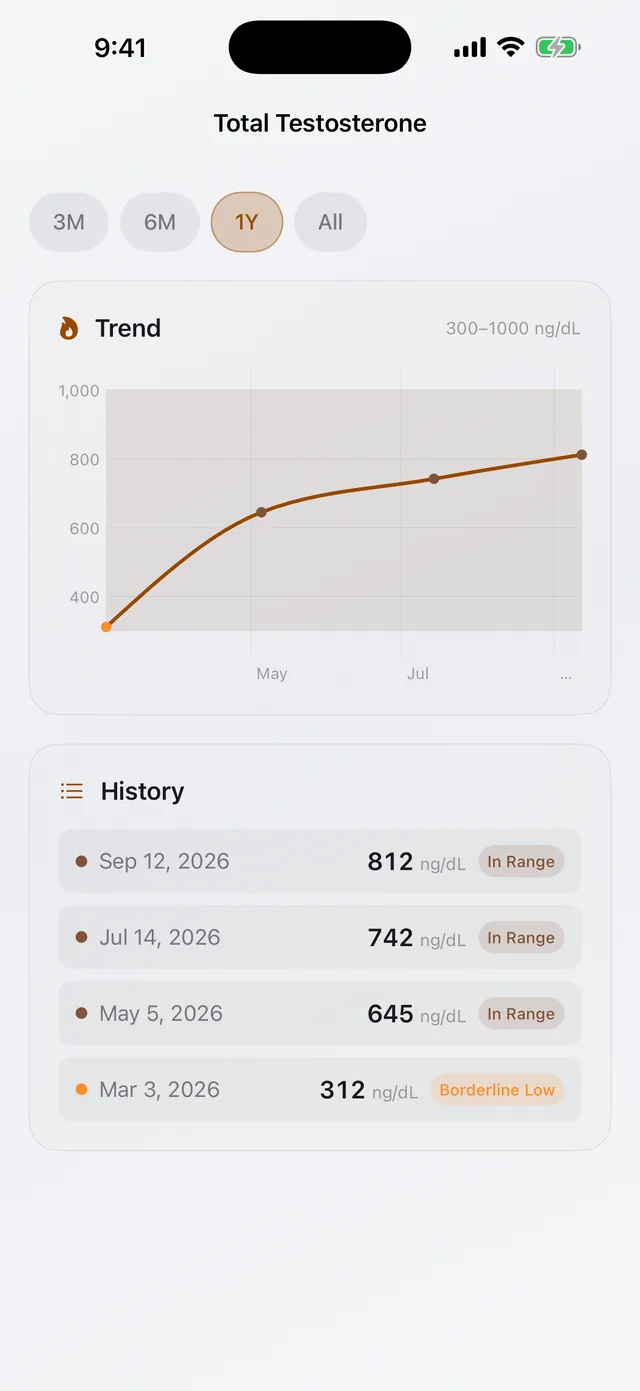
HDL (high-density lipoprotein) is the "good" cholesterol — it transports cholesterol back to the liver for excretion. In My TRT App you can log HDL after each draw and see it next to your dose history. Each lab sets its own reference range, so compare against the range printed on your report.
What it is
HDL (high-density lipoprotein) is the "good" cholesterol — it transports cholesterol back to the liver for excretion. TRT and AAS notoriously suppress HDL.
Reference range
| Reference range | Unit |
|---|---|
| > 40 | mg/dL |
Reference: >40 mg/dL. Optimal: >60.
What moves it
- Exercise, alcohol (modest), some genetic variants.
- TRT and especially AAS, sedentary lifestyle, smoking, obesity, insulin resistance.
On TRT
HDL drops on TRT — typically by 5–15 mg/dL. This was historically a concern for cardiovascular risk, but recent data suggests HDL is more of a marker than a mediator. Still, persistently low HDL (<35) combined with high LDL or ApoB is worth attention. Exercise and weight loss raise HDL more reliably than dietary interventions.
Related markers
FAQ
What is a normal HDL cholesterol level for men?
For men, HDL under 40 mg/dL (under about 1.0 mmol/L) is considered low, above 40 is the reference minimum, and 60 mg/dL or higher (about 1.6 mmol/L) is regarded as protective. Higher HDL has traditionally been viewed as favorable, though recent data suggests very high HDL is not automatically better. Compare your value against the reference range on your own lab report.
How do I convert HDL from mmol/L to mg/dL?
Multiply the mmol/L value by 38.67 to get mg/dL, and divide by 38.67 to convert back. For example, 1.0 mmol/L is about 40 mg/dL and 1.6 mmol/L is roughly 60 mg/dL. US labs report mg/dL, while UK, European, and Scandinavian labs report mmol/L, so a UK reading of 1.3 mmol/L is around 50 mg/dL.
Does TRT lower HDL cholesterol?
Yes. A drop in HDL is one of the most consistent lipid effects of testosterone therapy, typically 5-15 mg/dL, and higher-dose or anabolic androgen use can suppress it much more sharply. This was historically a cardiovascular concern, but current thinking treats HDL as more of a marker than a direct cause of risk. A persistently low HDL combined with high LDL or ApoB is still worth attention with your prescriber.
How can I raise my HDL cholesterol?
Regular aerobic exercise and losing excess body fat raise HDL more reliably than dietary changes alone, and quitting smoking helps too. On TRT, some of the drug-related HDL suppression will not fully reverse through lifestyle, so the goal is usually to keep the overall lipid picture healthy rather than to chase a specific HDL number. Discuss targets with your physician in the context of your LDL and ApoB.
Is a low HDL, like 35, a problem?
An HDL of 35 mg/dL is below the reference minimum of 40 for men and is often seen with a sedentary lifestyle, excess weight, insulin resistance, smoking, or testosterone use. It matters most when paired with high LDL, high triglycerides, or a raised ApoB, which together point to greater cardiovascular risk. On its own a modestly low HDL is a prompt to look at the whole panel with your physician, not an emergency.
Read it in context, not alone.
One HDL result is a snapshot. Logging each result in My TRT App next to your dose timing gives you and your prescriber a clearer picture over time.
Last reviewed 2026-09-02. Education only, not medical advice. Always talk to your prescriber.
Log this marker after every draw.
Scan your lab report and see each result on a trend line.